Post Merger IT Integration Guide: Process, Framework, Challenges, and Best Practices
A merger or acquisition can create new market opportunities, expand capabilities, and bring two organizations closer to a shared business goal. But after the deal closes, the real work begins.
For enterprise IT teams, post merger integration is rarely simple. Two companies may now need to operate as one, but their technology environments were often built separately over many years. Each organization may have its own identity systems, cloud platforms, Microsoft 365 tenant, security policies, applications, devices, vendors, data structure, and support model.
This is why post merger IT integration needs a clear plan. It is not only a technical migration. It is a structured business and technology process that helps the combined organization reduce risk, maintain continuity, improve security, and build a stronger operating model after the transaction.
A rushed integration can create confusion for users, expose sensitive data, increase security gaps, and slow down business operations. A well-planned integration gives leadership better visibility, gives employees a smoother experience, and gives IT teams a clear path for moving from two separate environments to one aligned technology strategy.
This guide explains what post merger integration means from an IT perspective, common post merger integration challenges, the role of a post merger integration manager, the post merger integration process, and the best practices enterprise teams should follow.
What Is Post Merger Integration?
Post-merger integration is the process of bringing two organizations together after a merger or acquisition. It includes people, processes, systems, operations, governance, culture, and technology.
From an IT perspective, post merger integration focuses on how the combined organization will manage users, devices, applications, data, infrastructure, cloud platforms, security controls, and collaboration systems.
In simple terms, post merger IT integration answers questions such as:
- How will employees access business systems after the deal closes?
- Which identity platform will become the primary source of access?
- Will both companies continue using separate Microsoft 365 tenants, or will they move toward tenant consolidation?
- How will email, Teams, SharePoint, OneDrive, and calendars work across both organizations?
- Which applications are business-critical?
- What security controls need to be aligned first?
- What cloud platforms, subscriptions, and infrastructure need to be reviewed?
- How will IT support users during the transition?
- What should be integrated now, and what should remain separate for a period of time?
The answer is not always immediate consolidation. In many enterprise environments, a phased approach is safer and more practical. Some systems may need to be integrated quickly for business continuity. Others may need more time because of compliance, application dependencies, data risk, or operational complexity.
The goal of post merger IT integration is not to move everything as fast as possible. The goal is to create a secure, stable, and manageable technology environment that supports the business after the deal.
Why Post Merger IT Integration Is Different from a Normal IT Project
Post merger IT integration is not the same as a standard migration, modernization project, or infrastructure upgrade.
In a normal IT project, the organization usually understands its own environment. The systems are known. Ownership is clearer. Security policies are already in place. Timelines may be planned around normal business cycles.
In a merger or acquisition, IT teams often inherit an environment they did not design. Documentation may be incomplete. Security controls may not match. User access may be inconsistent. Applications may depend on older systems. Some platforms may be duplicated. Some systems may be business-critical but poorly understood.
That makes post merger IT integration more complex.
The IT team must support business continuity while also evaluating risk. Employees need access to email, files, applications, and collaboration tools from day one. Leadership wants progress quickly. Security teams need to understand inherited exposure. Compliance teams need confidence that regulated data is protected. Finance teams want to understand licensing, vendor contracts, and cost overlap.
This creates pressure from multiple directions.
The most successful post-merger integrations usually begin with stabilization, not consolidation. Before moving users, merging tenants, or retiring systems, the combined organization needs to understand what exists, what matters most, what carries the highest risk, and what decisions may create disruption.
A strong post-merger integration framework helps enterprise teams avoid reactive decisions. It gives IT leaders a structured way to assess, stabilize, plan, integrate, and optimize the environment over time.
Common Post Merger Integration Challenges
Every deal is different, but many post merger integration challenges follow a similar pattern. The acquired environment may look stable on the surface, but once IT teams begin reviewing the details, hidden risks often appear.
One common challenge is identity complexity. Two organizations may have separate Microsoft Entra ID tenants, legacy Active Directory forests, different domain structures, duplicate users, unmanaged guest accounts, service accounts, and inconsistent administrator roles. If identity is not reviewed early, users may receive too much access, lose access to critical systems, or continue using outdated authentication methods.
Key identity concerns often include:
- Duplicate user accounts and conflicting usernames
- Inconsistent MFA and authentication policies
- Excessive privileged access and stale administrator accounts
- Unmanaged guest users and third-party access
Common Microsoft 365 issues include:
- Cross-tenant collaboration limitations
- Inconsistent retention and compliance settings
- Duplicate distribution lists and shared mailboxes
- Uncontrolled external sharing permissions
Another challenge is Microsoft 365 complexity. Teams, Exchange, SharePoint, OneDrive, calendars, and external sharing settings may be configured differently across both organizations. Employees may need to collaborate across tenants before a formal migration takes place. File permissions may be too broad. SharePoint sites may contain sensitive data with limited governance. Teams channels may include external users or outdated access groups.
Security alignment is also difficult. One organization may use strong MFA and Conditional Access policies, while the other may have weaker controls. Endpoint protection, monitoring, data loss prevention, SIEM coverage, and incident response processes may not be consistent. This creates uneven risk across the combined organization.
Areas that frequently require security review include:
- Conditional Access and MFA enforcement
- Endpoint security and device compliance
- Security monitoring and incident response coverage
- Data protection and loss prevention controls
Typical cloud infrastructure challenges include:
- Different governance and subscription models
- Inconsistent backup and disaster recovery strategies
- Overlapping cloud services and resources
- Limited visibility into cloud spending
Cloud infrastructure can also become fragmented. Azure subscriptions, management groups, resource groups, networks, workloads, backups, policies, monitoring tools, and cost structures may be organized differently. Without governance, the combined cloud environment can become harder to secure and more expensive to manage.
Application ownership is another major challenge. Some applications may support finance, operations, customer service, legal, HR, or production teams. But ownership may not be documented clearly. Integrations between applications may depend on older APIs, service accounts, shared mailboxes, or legacy authentication. Retiring or moving one system too early can affect another system that depends on it.
Common application-related risks include:
- Missing or unclear application ownership
- Undocumented integrations and dependencies
- Legacy authentication methods
- Unsupported or outdated software
Examples of overlap may include:
- Multiple endpoint security platforms
- Duplicate collaboration or productivity tools
- Separate backup and recovery solutions
- Conflicting vendor support agreements
Licensing and vendor overlap can also create confusion. Two companies may pay for similar tools, overlapping Microsoft licenses, duplicate security platforms, multiple backup solutions, and different support contracts. Cost reduction is possible, but cutting too early can create operational risk.
The biggest challenge is timing. Business leaders may expect the organization to operate as one company quickly. IT teams, however, need time to assess the environment, reduce risk, plan migrations, and protect users from disruption. A clear postmerger integration plan helps balance business urgency with technical reality.
Timing-related challenges often include:
- Pressure to accelerate migrations
- Limited visibility into inherited systems
- Competing business and technical priorities
- Resource constraints across integration teams
The Role of a Post Merger Integration Manager
A post merger integration manager helps coordinate the integration across teams, timelines, risks, and business priorities. In enterprise environments, this role is important because post merger integrations involve more than one department.
The integration manager may work with executives, IT leaders, security teams, legal, finance, HR, compliance, business unit owners, vendors, and project managers. The goal is to keep the integration organized and aligned with the business case behind the deal.
From an IT perspective, the post-merger integration manager helps make sure that technology decisions are not made in isolation. For example, a tenant migration may affect HR onboarding, legal discovery, finance reporting, customer service, compliance records, and executive communication. A cloud migration may affect application performance, security monitoring, data residency, and vendor contracts.
The integration manager does not need to make every technical decision. But this role should help clarify priorities, remove blockers, track risks, and make sure the right people are involved before major decisions are made.
A strong post merger integration manager usually focuses on
Defining integration workstreams
Aligning IT priorities with business goals
Tracking risks, dependencies, and open decisions
Coordinating timelines across teams
Supporting communication between leadership and technical teams
Helping teams separate urgent Day 1 needs from longer-term integration work
Making sure the post merger integration plan remains realistic
Escalating issues before they become larger problems
The role is especially valuable when the deal includes complex Microsoft environments, multiple cloud platforms, regulated data, global users, legacy infrastructure, or a large number of business applications.
Without clear ownership, post merger integration can become a collection of disconnected projects.
With the right management structure, teams can work from a shared plan and make better decisions.
Post-Merger IT Integration Framework
A practical post merger integration framework gives enterprise teams a clear way to move from uncertainty to control. It helps avoid random decisions and supports phased execution.
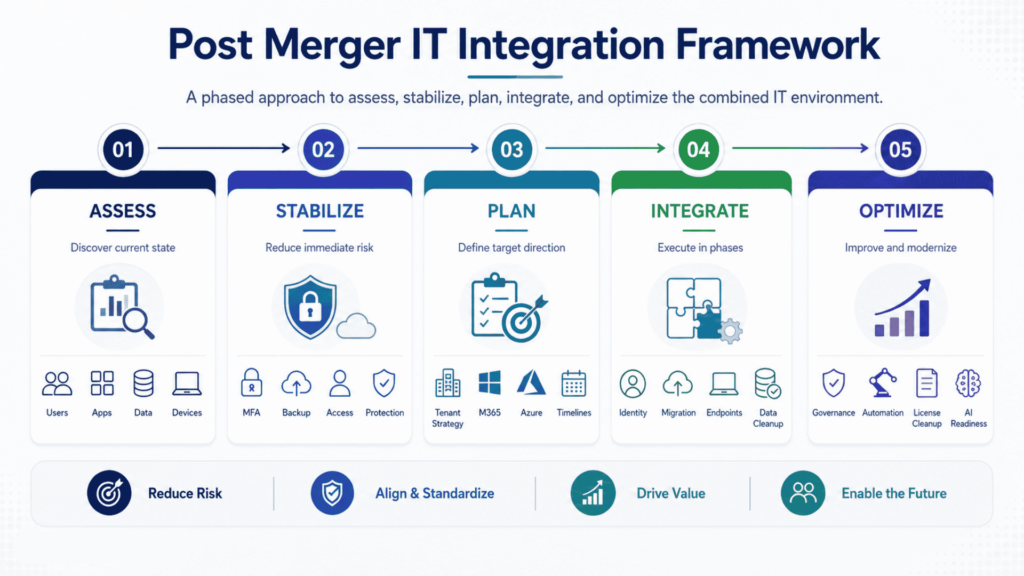
A simple framework can include five phases: assess, stabilize, plan, integrate, and optimize.
1. Assess
The first phase is to understand the current state. This includes users, identity systems, applications, data, devices, cloud platforms, infrastructure, security controls, contracts, licenses, and support processes.
The assessment should not only focus on technical assets. It should also identify business-critical systems, regulatory requirements, operational dependencies, and areas where disruption would create business impact.
This phase helps IT leaders answer a basic but important question: what did we inherit?
2. Stabilize
The second phase is stabilization. The goal is to protect business continuity and reduce immediate risk.
This may include securing privileged accounts, reviewing administrator access, enabling or enforcing MFA, confirming backup coverage, validating endpoint protection, reviewing external sharing, and making sure users can access the systems they need.
Stabilization should happen before major consolidation work. If the environment is unstable or poorly understood, large migrations can create unnecessary risk.
3. Plan
The third phase is planning. At this stage, the organization defines its target direction.
This may include decisions about tenant strategy, identity integration, Microsoft 365 migration, Azure governance, application rationalization, endpoint management, security operations, data protection, and vendor consolidation.
A good post merger integration plan should include timelines, ownership, dependencies, risks, success measures, and communication needs. It should also separate short-term actions from long-term modernization work.
4. Integrate
The fourth phase is controlled integration. This is where teams begin executing approved migration and alignment work.
Depending on the organization, this may include identity consolidation, Microsoft 365 tenant migration, Teams collaboration alignment, SharePoint governance changes, Azure subscription restructuring, endpoint enrollment, security tool integration, application migration, and data cleanup.
The key is to integrate in phases. A phased approach reduces disruption and gives IT teams time to test, communicate, and adjust.
5. Optimize
The final phase is optimization. After the main integration work begins, the organization should look for ways to improve the operating model.
This may include reducing duplicate tools, improving governance, strengthening security policies, improving reporting, automating device provisioning, cleaning up unused applications, reducing license waste, and preparing the environment for future initiatives such as AI and Copilot.
Optimization is where the combined organization begins to move beyond the deal and build a stronger technology foundation for the future.
Post Merger Integration Process: Step-by-Step
A post merger integration process should be structured enough to guide teams, but flexible enough to adapt to deal size, industry requirements, and technical complexity.
The following process can help enterprise teams organize the work.
Step 1: Review due diligence findings
Start with the information collected before the deal closed. Due diligence findings may include known technology risks, application lists, security concerns, contracts, infrastructure details, and compliance requirements.
However, due diligence is often limited. After the deal closes, IT teams usually need a deeper review to confirm what is accurate, what has changed, and what was not visible before closing.
Step 2: Build the integration team
Post merger IT integration requires input from multiple groups. The team may include IT leadership, infrastructure, cloud, identity, security, compliance, endpoint management, collaboration, application owners, business leaders, HR, finance, legal, and vendors.
The team should agree on decision rights, escalation paths, communication expectations, and workstream ownership.
Step 3: Confirm business priorities
Not every system has the same level of importance. Some systems support revenue, customer operations, finance, legal obligations, employee access, or regulated processes. These systems should receive priority attention.
Business priorities help IT teams avoid treating every task as equally urgent.
Step 4: Map the current environment
The next step is to create a reliable view of the current environment. This includes users, groups, devices, applications, servers, cloud subscriptions, data stores, licenses, vendors, security tools, and collaboration platforms.
The goal is not perfect documentation on day one. The goal is enough visibility to make safe decisions.
Step 5: Secure privileged access
Privileged access should be reviewed early. Admin accounts, service accounts, emergency access accounts, third-party access, and elevated roles can create major risk if they are not controlled.
This step may include reviewing global administrators, enforcing MFA, limiting standing privileges, removing stale admin access, and creating a clear process for privileged role assignment.
Step 6: Define identity and access direction
Identity is usually one of the most important decisions in post merger IT integration. Teams need to decide how users will authenticate, how access will be managed across environments, and whether the organization will use coexistence, staged migration, or consolidation.
The identity plan should consider user experience, security, business timelines, application dependencies, and long-term governance.
Step 7: Plan collaboration across teams
Employees often need to work together soon after the deal closes. Email, calendars, Teams, SharePoint, OneDrive, and file sharing must be reviewed carefully.
The organization may need short-term collaboration controls before long-term tenant decisions are complete. This helps users work together while reducing the risk of oversharing or uncontrolled external access.
Step 8: Review infrastructure and cloud dependencies
Cloud and infrastructure teams should review Azure subscriptions, workloads, networks, backups, monitoring, policies, and operational ownership.
If both organizations use Azure differently, the combined environment may need a new governance model. This can include management group structure, subscription organization, policy standards, network design, logging, and cost management.
Step 9: Align security and compliance controls
Security alignment should run across the full integration process. Teams should review MFA, Conditional Access, endpoint security, threat detection, data protection, audit logging, SIEM coverage, incident response, and compliance requirements.
The goal is to reduce uneven security between the two organizations and create a consistent baseline.
Step 10: Build the roadmap
The roadmap should define what happens first, what happens later, and what depends on other work. It should include timelines, risks, workstream owners, major milestones, and communication plans.
A good roadmap should also show what will not be integrated immediately. This is important because some systems may need to remain separate for legal, regulatory, technical, or operational reasons.
Step 11: Execute in phases
Post merger integrations are safer when they are phased. Teams can start with urgent risk reduction and user access needs, then move toward larger integration work such as tenant migration, application consolidation, and cloud restructuring.
Phased execution also gives users time to adjust and gives IT teams time to validate each step.
Step 12: Measure progress and adjust
Post-merger IT integration is not a one-time project plan that stays fixed from start to finish. New risks may appear. Business priorities may change. Some systems may be more complex than expected.
Teams should track progress regularly and adjust the plan based on business impact, technical findings, and user feedback.
What to Include in a Post-Merger Integration Plan
A post-merger integration plan turns strategy into action. It should give leadership and delivery teams a shared view of what will happen, who owns each workstream, and how progress will be measured.
A strong plan usually includes the following elements.
Business objectives
The plan should begin with the business reason behind the integration. Is the goal to create one operating model, reduce duplicate systems, improve security, support growth, meet compliance requirements, or prepare for a larger transformation?
Clear business objectives help IT teams make better decisions
Current-state summary
The plan should summarize what is known about both technology environments. This may include identity platforms, Microsoft 365 tenants, Azure subscriptions, applications, data stores, endpoints, infrastructure, support tools, and vendors.
The summary should also note areas where information is incomplete.
Integration scope
The plan should define what is included and what is not included. This helps prevent scope confusion.
For example, the first phase may include identity stabilization, collaboration access, security alignment, and application discovery. Later phases may include tenant migration, application consolidation, cloud redesign, and data governance improvements.
Workstream ownership
Each major area should have an owner. Common workstreams include identity, Microsoft 365, security, cloud, endpoints, applications, data, compliance, communications, and change management.
Clear ownership reduces delays and avoids duplicate work.
Risk register
A risk register should track security, compliance, migration, operational, vendor, and user experience risks. Each risk should have an owner, severity level, mitigation plan, and status.
This is especially important because post-merger integrations often include inherited risks that were not visible during early planning.
Timeline and milestones
The plan should include a realistic timeline. It can be organized by Day 1, first 30 days, first 60 days, first 90 days, and longer-term phases.
Milestones should be meaningful. Instead of only tracking tasks, the plan should track outcomes such as secured admin access, confirmed application ownership, collaboration controls in place, identity roadmap approved, or priority systems migrated.
Communication plan
User communication matters. Employees need to know what is changing, when it is changing, and how it affects their daily work.
The communication plan should include leadership updates, IT support communication, end-user notices, training needs, and escalation channels.
Success measures
The plan should define how progress will be measured. Useful measures may include reduced security risk, fewer duplicate tools, improved user access, lower licensing waste, better endpoint compliance, migration completion, improved support response, and stronger governance.
Success should not only be measured by technical completion. It should also be measured by business continuity, user experience, and risk reduction.
Post-Merger Integration Best Practices
Post-merger integration best practices help enterprise teams reduce disruption and make better long-term decisions.
Start with stability before consolidation
It is natural for leadership to want one company, one platform, and one operating model quickly. But immediate consolidation can be risky if the environment is not fully understood.
Stabilize first. Confirm access, secure privileged roles, review critical systems, and make sure users can continue working. Then plan consolidation in phases.
Treat identity as a priority
Identity controls access to applications, data, devices, and cloud platforms. If identity is not managed properly, the combined organization may inherit weak passwords, stale accounts, excessive privileges, unmanaged guests, and inconsistent access policies.
Review identity early and keep it central to the integration plan.
Do not assume both environments have the same risk level
Two companies may use similar tools but have very different security maturity. One may have strong conditional access and endpoint compliance. The other may rely on older authentication, local admin rights, or limited monitoring.
Post-merger IT integration should identify these differences and create a consistent baseline.
Protect collaboration without opening everything
Employees need to work together, but broad access can create data exposure. Review Teams, SharePoint, OneDrive, external sharing, guest access, and file permissions before expanding collaboration.
The goal is to support productivity while keeping access controlled.
Build a phased roadmap
A single large migration plan can become difficult to manage. A phased roadmap is easier to communicate, easier to track, and safer to execute.
Start with high-risk and business-critical areas. Then move toward deeper integration and optimization.
Keep compliance involved early
Compliance should not be added at the end of the project. If the companies operate in regulated industries, integration decisions may affect retention, audit logs, data residency, legal holds, privacy, and reporting.
Involve compliance and legal teams early so technical decisions do not create downstream risk.
Understand application dependencies before making changes
Applications often depend on identity systems, databases, file shares, APIs, service accounts, email relays, or network connections. Removing or changing one system can affect others.
Application dependency mapping helps prevent business disruption.
Communicate clearly with users
Even well-planned integrations can create frustration if users are not informed. People need simple instructions, clear timelines, and a place to get help.
Communication should be practical, not overly technical. Explain what is changing and what users need to do.
Track decisions, not just tasks
Post-merger IT integration includes many decisions: tenant strategy, identity model, security baseline, cloud governance, application ownership, vendor consolidation, and data management.
Tracking decisions helps teams stay aligned and creates a useful record for future phases.
Plan for the future operating model
Integration should not only focus on combining what exists. It should also define how the new organization will operate going forward.
That includes governance, support processes, security operations, endpoint management, cloud standards, application lifecycle management, and reporting.
First 100 Days Post-Merger IT Integration Roadmap
The first 100 days are important because they set the tone for the full integration. This period should focus on business continuity, risk reduction, visibility, and planning.

Day 0 to 15: Secure and stabilize
The first two weeks should focus on urgent access, security, and operational continuity.
Key priorities include reviewing administrator accounts, confirming business-critical systems, validating backups, checking endpoint protection, reviewing external access, and making sure employees can continue working.
This is also the time to confirm escalation paths and support coverage.
Day 15 to 30: Build visibility
The next phase should focus on discovery and documentation.
Teams should map users, groups, applications, devices, cloud platforms, data locations, vendors, licenses, and security tools. They should also identify incomplete information and areas that need deeper investigation.
The goal is to create enough visibility to support planning.
Day 30 to 60: Define the integration direction
By this stage, the organization should begin defining its target direction.
This may include decisions around tenant strategy, identity integration, collaboration model, cloud governance, endpoint management, application rationalization, security standards, and compliance requirements.
The roadmap should separate urgent actions from long-term transformation.
Day 60 to 90: Begin controlled integration
Once priorities are clear, teams can begin phased integration work.
This may include aligning access policies, standardizing security controls, improving collaboration governance, migrating priority users or workloads, consolidating selected tools, and improving support processes.
Changes should be tested, communicated, and monitored.
Day 90 to 100: Review and optimize
Near the end of the first 100 days, leadership should review progress against the plan.
This review should look at risk reduction, user experience, cost overlap, migration progress, unresolved dependencies, and future phases. It should also identify where the operating model needs to mature.
The first 100 days will not complete every integration task. But they should create control, clarity, and momentum.
Common Mistakes to Avoid
Post merger IT integration becomes harder when teams move too fast without enough visibility. The following mistakes are common in enterprise environments
Treating IT integration as only a migration project
Migration is only one part of the work. Post-merger IT integration also includes access, security, governance, support, compliance, applications, data, and user experience.
A narrow migration-only view can miss important risks.
Waiting too long to review identity and access
Identity should be reviewed early. If stale users, excessive permissions, unmanaged guests, or weak admin controls remain in place, the combined organization may carry unnecessary risk.
Consolidating before understanding dependencies
Some systems are deeply connected to other applications, users, reports, and business processes. Consolidating too early can create downtime or data issues.
Ignoring collaboration risk
Teams, SharePoint, OneDrive, and email are often used heavily during integration. Without governance, sensitive data can be shared too broadly.
Underestimating endpoint differences
Devices may be managed differently across both organizations. Some may not meet security standards. Others may not be enrolled in the preferred management platform.
Endpoint visibility is important for security and support.
Not involving business owners
IT teams can identify systems, but business owners understand how those systems are used. Without business input, integration plans may miss important operational details.
Focusing only on Day 1
Day 1 access is important, but it is not the full integration. Teams also need a long-term plan for governance, modernization, security, cost optimization, and support.
Poor communication
Users may become confused if they do not understand what is changing. Poor communication can increase help desk tickets, reduce productivity, and create frustration.
A clear communication plan helps reduce avoidable disruption
Conclusion
Post-merger IT integration is one of the most important parts of a successful merger or acquisition. It affects how employees work, how systems connect, how data is protected, how security is managed, and how the combined organization operates after the deal.
A strong post-merger integration process starts with assessment and stabilization. It then moves into planning, phased integration, and long-term optimization. This approach helps enterprise teams reduce risk, protect business continuity, and make better technology decisions.
The most effective post merger integrations are not rushed. They are structured, business-aware, and security-focused. They recognize that not every system needs to be consolidated immediately and that some integration decisions require careful planning.
For enterprise IT leaders, the goal is simple: create a technology environment that supports the new organization without creating unnecessary disruption or risk.
With a clear post-merger integration framework, a practical integration plan, and strong coordination across teams, organizations can move from inherited complexity to a more stable, secure, and scalable operating model.