Microsoft Foundry: Scale Innovation on a Modular, Interoperable, and Secure Agent Stack
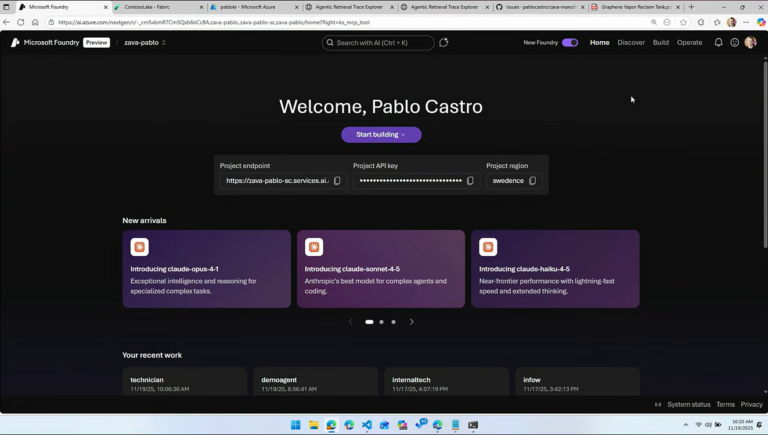
At Microsoft Ignite 2025, one message stood out clearly: the future of enterprise AI will be built and governed through intelligent agents. As organizations shift from AI experiments to full-scale deployment, Microsoft introduced Microsoft Foundry, a modular and secure agent stack designed to help enterprises build, run, and scale production-grade AI agents with confidence.
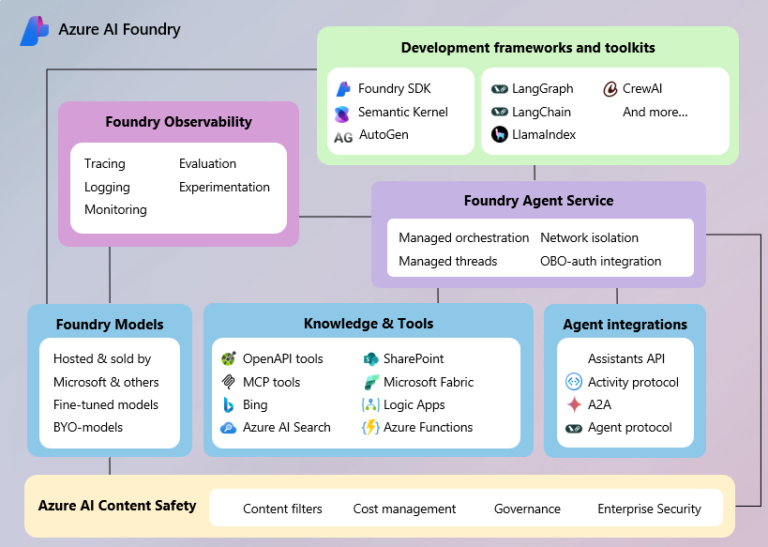
Foundry brings together models, tools, knowledge, governance, and observability into one unified platform, giving teams the power to move from prototypes to real, operational AI systems faster than ever. Whether you’re modernizing existing applications or building intelligent multi-agent workflows, Foundry provides the foundation needed to innovate safely and at scale.
Table of Contents
- The Agent Transformation
- Components of the Agent Stack
- Expanding Reach and Modernization
Key Takeaways
- Foundry is the “AI App and Agent Factory”: It provides a modular, interoperable, and secure agent stack designed for building and scaling enterprise intelligence.
- Unmatched Model Choice and Routing: Foundry offers over 11,000 models, including the latest Anthropic and Cohere models, with the Model Router (GA) dynamically selecting the best fit for efficiency and quality.
- Dynamic Knowledge Grounding: Foundry IQ (public preview) transforms RAG into a dynamic reasoning process using Azure AI Search, simplifying complex data grounding across sources.
- Comprehensive Agent Management: Foundry Agent Service (public preview) supports Hosted Agents, Multi-Agent Workflows, and secure Memory across sessions, streamlining the deployment of sophisticated systems.
- Security Across the Lifecycle: The Foundry Control Plane (public preview) centralizes governance and observability, while the integration of Defender for Cloud and GitHub Advanced Security protects agents from code inception through deployment.
The Agent Transformation
The nature of software is currently being reshaped by agents. These systems are moving beyond rigid workflows to become systems that reason, adapt, and act with purpose. Agents are no longer simple assistants; they are dynamic collaborators layered within everyday tools. This shift necessitates a consistent platform for building intelligence at scale.
Microsoft Foundry is designed as this foundational platform, sometimes referred to as the “AI app and agent factory”. Foundry helps builders realize this vision by providing a modular, interoperable, and secure agent stack. The platform delivers a powerful, simple, and trusted path for developers to achieve production AI apps and agents.
Deep Dive: Components of the Agent Stack
The core of Microsoft Foundry is built around several interconnected services that unify models, tools, and knowledge into one open system.
Foundry Models: Choice and Optimization
Innovation requires adaptability and choice. Foundry Models offers the broadest selection of models available on any cloud, with more than 11,000 frontier models accessible to teams. Developers are empowered to benchmark, compare, and dynamically route models to optimize performance for every task.
Recent announcements include the availability of Anthropic’s Claude Sonnet 4.5, Opus 4.1, and Haiku 4.5 in Foundry. Azure is now the only cloud offering both OpenAI and Anthropic models. Additionally, Cohere’s leading models have joined Foundry’s first-party model lineup.
- Model Router is now generally available (GA). This feature allows AI applications and agents to dynamically select the best-fit model for each prompt, ensuring an optimal balance of cost, performance, and quality. Model router is also in public preview in Foundry Agent Service, supporting the development of more adaptable and efficient agents, which is especially helpful for multi-agent systems.
- A new Developer Tier (public preview) increases accessibility for model fine-tuning by leveraging idle GPU capacity.
Foundry IQ: Empowering Agents with Knowledge
The reliability and productivity of an agent increase with the context it possesses. Foundry IQ, now available in public preview, redefines retrieval-augmented generation (RAG). Instead of a one-time lookup, it operates as a dynamic reasoning process.
Powered by Azure AI Search, Foundry IQ centralizes RAG workflows into a single grounding API. This process simplifies orchestration, improves response quality, and respects user permissions and data classifications.
Key features
- Simplified cross-source grounding that does not require upfront indexing.
- Capabilities like multi-source selection, iterative retrieval, and reflection to dynamically enhance the quality of agent interactions.
- Integration with Foundry Agent Service enriches agent context within a single, observable runtime.
Foundry already handles over 3 billion search queries daily. The combination of Foundry IQ with Microsoft Fabric IQ and Work IQ from Microsoft 365 Copilot provides an unparalleled context layer for agents.
Foundry Agent Service: Context-Aware and Action-Oriented
Agents must have access to the same tools and knowledge used by the individuals they support. Foundry Agent Service empowers developers to build sophisticated single and multi-agent systems, integrating models, knowledge, and tools into a single, observable runtime.
Key public preview announcements include
- Hosted Agents allow developers to run agents built using Microsoft or third-party frameworks in a fully managed environment, enabling concentration on agent logic rather than operational maintenance.
- Multi-agent workflows coordinate specialized agents to execute complex, multi-step business processes. These workflows support long-running, stateful collaboration and include built-in recovery and debugging.
- Memory enables agents to securely retain context across sessions. This capability reduces the complexity of external data stores and allows for more personalized interactions out of the box.
- Microsoft 365 and Agent 365 integration enables instant deployment of agents from Foundry to Microsoft productivity apps. This deployment leverages Agent 365 for secure orchestration, governance, and enterprise-grade deployment.
Foundry Tools: Enabling Action
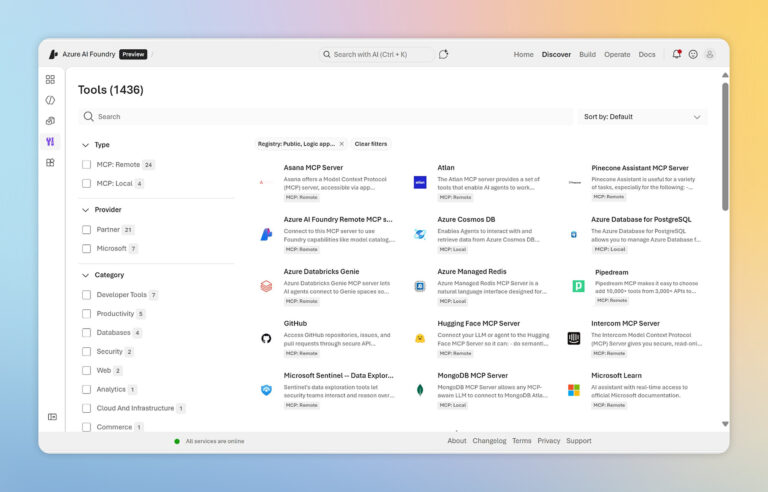
Appropriate tools can transform agents from simple responders into intelligent problem-solvers. Foundry Tools, now in public preview, equips agents with secure, real-time access to business systems, business logic, and multimodal capabilities.
Developers can leverage Foundry Tools to
- Connect agents to real-time business data and events using more than 1,400 connectors for business systems such as SAP, Salesforce, and UiPath.
- Find, connect, and manage public or private tools for agents from a single, secure interface.
- Expose any API or function as a Managed Control Plane (MCP) tool via API Management, reusing existing business logic to accelerate time-to-value.
- Enrich workflows with out-of-the-box tools for capabilities like transcription, translation, and document processing.
Foundry Control Plane: Security and Governance
Scaling intelligence demands trust and strong governance. Foundry Control Plane, now in public preview, centralizes identity, controls, observability, and security signals into one portal. This helps teams build, operate, and govern agents with confidence.
Key capabilities include
- Controls that apply unified guardrails across inputs, outputs, and tool interactions, keeping agents focused and within defined boundaries.
- Observability features, including built-in evaluations, OTel-based tracing, continuous red teaming, and dashboards that surface insights on quality, performance, safety, and cost.
- Security anchored in Entra Agent ID, Defender, and Purview, providing durable identity, policy-driven access, integrated data protection, and real-time risk detection throughout the agent lifecycle.
A new integration between Microsoft Defender for Cloud and GitHub Advanced Security (public preview) closes the gap between security and development teams. Developers receive AI-suggested fixes directly inside GitHub, while security teams track progress in Defender for Cloud in real time, ensuring a more connected way to secure AI systems across the full app lifecycle.
Expanding Reach and Modernization
Foundry Local: Powering Cloud to Edge
Foundry Local, previously launched on Windows and Mac, has reached 560 million devices. It brings intelligence directly into the environments where work happens.
Foundry Local is now in private preview on Android, the world’s most widely used mobile platform. This expansion means agents can run natively on billions of phones, enabling real-time inference, privacy-aware computation, and resilience, even when connectivity is unpredictable.
Modernizing Applications for AI
Building new AI applications or integrating AI into existing applications requires a modern foundation. Managed Instance on Azure App Service, available in public preview, allows organizations to move existing .NET web applications to the cloud with only a few configuration changes. This leads to faster migrations with lower overhead and immediate access to cloud-native scalability and the AI capabilities within Microsoft Foundry.
Conclusion
Microsoft Foundry gives enterprises a clear and secure way to build and scale AI agents with confidence. By unifying models, knowledge, tools, and governance into one modular stack, it helps teams move from experimentation to real production systems. With the updates announced at Microsoft Ignite, Foundry is becoming the backbone for creating intelligent, reliable, and enterprise-ready agents that can power the next wave of innovation.
Frequently Asked Questions (FAQs)
What is Microsoft Foundry?
Microsoft Foundry is a modular, interoperable, and secure agent stack that helps enterprises build, deploy, and scale production-grade AI agents and applications. It combines models, tools, grounding, orchestration, and governance into one unified platform.
Why was Microsoft Foundry announced at Microsoft Ignite?
Ignite 2025 focused heavily on the rise of agentic AI. Foundry was introduced as the foundation for building enterprise-ready agents—helping organizations move from isolated pilots to scalable, governed AI systems.
How does Foundry differ from Azure AI services?
Azure AI provides models and infrastructure.
Foundry adds the full agent stack—grounding (Foundry IQ), orchestration (Agent Service), tools, memory, and a control plane for security and governance.
What types of models does Foundry support?
Foundry offers over 11,000 frontier models, including OpenAI, Anthropic (Claude 4.5 series), Cohere, and others. The Model Router helps pick the best model automatically based on cost, speed, or quality.
What is Foundry IQ, and why is it important?
Foundry IQ (public preview) is a dynamic grounding engine that turns RAG into a continuous reasoning process. It improves agent accuracy across multiple data sources and respects enterprise permissions and classifications.