M&A Due Diligence in 2026: Process, Requirements, and AI
M&A due diligence in 2026 is no longer limited to legal documents, financial statements, and a quick technology review before signing. Buyers now need a clearer picture of operational risk, cyber exposure, cloud complexity, identity sprawl, data governance gaps, and post-close integration cost before they decide what a business is really worth.
For enterprise buyers, that shift matters. A target can look strong on revenue, contracts, and market position while still carrying hidden risks inside Microsoft 365, Microsoft Entra ID, Azure subscriptions, legacy Active Directory, unmanaged devices, or overshared SharePoint environments that create security, continuity, and integration problems on Day 1.
Table of contents
- What Is M&A Due Diligence?
- Why Due Diligence Matters in 2026
- Key M&A Due Diligence Requirements
- The M&A Due Diligence Process
- Technology, Cloud, and Security Review
- How AI Supports Due Diligence
- Why Due Diligence Drives Better Integration
- Final Thoughts
Key takeaways
- M&A due diligence in 2026 is broader than finance and legal review; buyers must also assess cloud, identity, data, cybersecurity, AI governance, and integration readiness before closing.
- The strongest due diligence programs connect findings to valuation, purchase agreement protections, Day 1 readiness, and post-merger integration cost.
- Technology due diligence is now a major differentiator, especially in Microsoft environments where stale identities, tenant sprawl, weak access controls, and overshared collaboration sites can create inherited risk.
- AI can speed up document review, synthesis, and issue spotting, but it should support human review rather than replace legal, security, finance, and integration judgment.
- Buyers that review cloud, identity, security, and business continuity early are better positioned to reduce Day 1 disruption and avoid expensive cleanup after the deal closes.
What is due diligence in M&A?
Due diligence in M&A is the buyer’s structured review of a target company before signing or closing a transaction. Its purpose is to confirm what the buyer is acquiring, identify risks that could affect value, and determine whether the business can be integrated without creating legal, financial, operational, or security problems after the deal closes.
At a basic level, due diligence answers a few practical questions. Are the financials reliable? Are the contracts enforceable? Are there unresolved tax, legal, or compliance issues? Does the target really control its data, systems, applications, and identities? Can the combined business operate securely on Day 1 without disruption to users, customers, and critical services?
In 2026, those questions matter more because enterprise environments are more interconnected than they used to be. A business may rely on hybrid identity, shared cloud services, SaaS integrations, collaboration platforms, AI-enabled workflows, and distributed devices, which means weaknesses in one area can quickly affect many others during a merger or acquisition.
Why M&A due diligence matters more in 2026
The due diligence bar is higher in 2026 because deal teams are working in a more complex environment. AI is reshaping valuation and business models, regulators are paying closer attention to data, national security, and technology concentration, and buyers are expected to understand not only what a target owns today but how resilient that target will be over the next few years.
PwC’s 2026 M&A outlook says AI should be a core part of every deal review, including the target’s AI roadmap, capability needs, execution readiness, and likely three-to-five-year impact on value. At the same time, the EU AI Act entered into force on August 1, 2024, with major provisions applying from August 2, 2026, which makes AI governance a live diligence issue for companies operating in or serving Europe.
Cross-border deals also face higher review pressure. CFIUS has authority to review certain foreign investments and certain real estate transactions for national security risk, and its scope includes some non-controlling investments involving critical technology, critical infrastructure, and sensitive personal data.
This means due diligence is not just about avoiding surprises. It is about understanding whether the deal can close, how the purchase agreement should be structured, what remediation will be required after closing, and how much those realities should change the price.
M&A due diligence requirements: key areas buyers should review
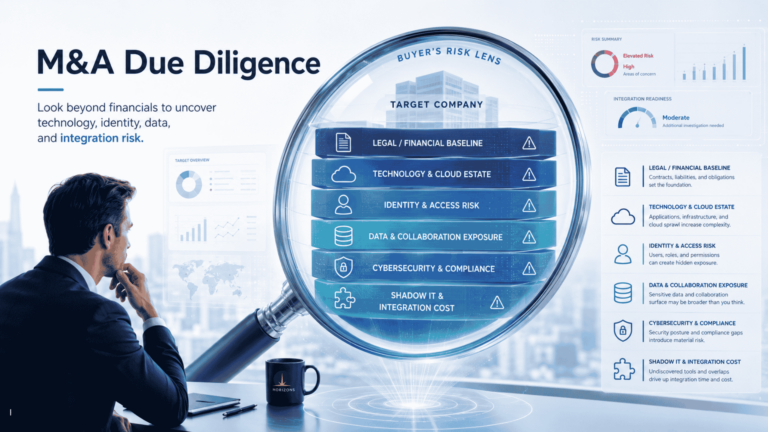
There is no fixed number of due diligence requirements in M&A, but most buyers review six to ten major workstreams depending on the deal size, industry, and regulatory profile. For enterprise transactions in 2026, the most important areas usually include legal, financial, tax, commercial, operational, technology, cybersecurity, privacy, and integration readiness.
Legal, corporate, and financial fundamentals
Buyers still need to confirm the basics first. That includes corporate structure, capitalization, board approvals, material contracts, litigation, tax exposure, debt obligations, revenue quality, customer concentration, and any obligations that could affect cash flow after the deal closes.
These workstreams remain essential because they set the legal and commercial baseline for the transaction. If ownership rights are unclear, contract terms change on acquisition, or revenue is overly dependent on a few customers, the buyer may need to renegotiate price, require specific indemnities, or walk away.
Technology, cloud, identity, data, and security
This is where many enterprise deals need deeper review than they get. A buyer should understand the target’s core systems, Azure subscription structure, Microsoft 365 tenant configuration, identity model, privileged access, device controls, data exposure, backup posture, and incident history before close.
In Microsoft environments, that means looking past surface-level licensing or tenant counts. Buyers should review Entra ID tenants, domains, user principal name patterns, duplicate identities, cross-tenant B2B relationships, Conditional Access policies, MFA coverage, break-glass accounts, privileged roles, app registrations, and service principals.
The same is true for hybrid identity. A target may still depend on legacy Active Directory forests, trusts, SID history, Windows-integrated authentication, and aging line-of-business applications that complicate migration or coexistence planning after the deal closes.
Data governance and collaboration risk
Many buyers underestimate the risk created by collaboration sprawl. In Microsoft 365, overshared SharePoint sites, broad permission groups, unmanaged sharing links, and poor site ownership create real exposure because sensitive data can be widely accessible even if the company believes access is controlled.
Microsoft’s data access governance reporting is designed to identify potentially overshared or sensitive SharePoint sites, recent permission changes, and access patterns that may indicate exposure. In a diligence context, those signals matter because the buyer may inherit compliance risk, internal data leakage, and additional cleanup work before the combined environment can be trusted for Copilot, enterprise search, or cross-company collaboration.
Shadow IT and hidden integration cost
Another practical requirement is visibility into shadow IT. During M&A, unknown SaaS applications, undocumented OAuth integrations, local admin practices, unmanaged file-sharing tools, and business-led subscriptions can create access, security, and migration challenges that do not appear in financial statements alone.
That is why enterprise buyers increasingly combine questionnaire-based discovery with Entra ID application audits, procurement reviews, and identity-connected app analysis during due diligence. The goal is not only to discover risk but to estimate how much cleanup and rationalization will cost after close.
The M&A due diligence process: step-by-step
The M&A due diligence process usually begins before the letter of intent is signed. Buyers start with outside-in research to understand the market, business model, likely regulatory exposure, and technology profile of the target before they invest in a full review.
Step 1: define the deal thesis and risk questions
Strong diligence starts with a clear thesis. What capabilities is the buyer acquiring? What assumptions justify the valuation? Which risks would threaten business continuity, security, revenue, or integration? If those questions are unclear at the beginning, due diligence quickly becomes a document collection exercise instead of a decision-making process.
Step 2: scope workstreams and open the data room
Once the buyer advances, the diligence team defines workstreams, builds request lists, and opens the virtual data room. This phase should include clear ownership across finance, legal, tax, IT, security, cloud, identity, privacy, and integration planning so that issues found in one stream can be tested in others.
Step 3: review documents, systems, and control evidence
This is the core of diligence. Teams review contracts, policies, diagrams, cloud inventories, identity settings, audit records, incident history, architecture decisions, access controls, and business continuity evidence.
For Microsoft-heavy environments, that review should include at least the following:
- Entra ID tenants, domains, cross-tenant trust, B2B setup, and account duplication risk.
- Conditional Access, MFA, privileged access, emergency access accounts, and role design.
- Azure subscriptions, management groups, landing zones, security baselines, and ownership model.
- SharePoint, Teams, OneDrive, and access governance controls that may expose sensitive content.
- Legacy AD, hybrid identity dependencies, and applications that still require older authentication methods.
- Device posture, unmanaged endpoints, and the likelihood of Day 1 access disruption if policies are harmonized too quickly.
Step 4: quantify risk and model Day 1 impact
Good diligence does not stop at issue identification. Buyers need to translate findings into estimated remediation cost, likely impact on integration timing, potential business interruption, security exposure, and purchase agreement protections.
For example, if the target relies on stale identities, inherited privileged access, and unmanaged devices, the problem is not just a security note. It may delay tenant integration, increase help desk load, require parallel identity coexistence, and drive up consulting and internal labor costs in the first 90 to 180 days after close.
Step 5: Use findings to shape the deal
The final stage is decision support. Diligence findings should influence valuation, escrows, indemnities, representations, transition service needs, Day 1 controls, and the integration plan. The best outcomes happen when technology and security diligence are tied directly to deal structure instead of being deferred to the post-close IT team.
Technology due diligence: cloud, identity, data, and security
This is the section where enterprise buyers can separate generic diligence from useful diligence. In many modern deals, the largest post-close surprises are not hidden in the balance sheet. They are buried in tenant sprawl, inconsistent access policies, weak identity hygiene, poor data governance, and under-documented cloud ownership.
What buyers should review in Microsoft Entra ID
Entra ID should be reviewed as a control plane, not just a directory. Buyers should assess tenant count, namespace conflicts, duplicate identities, B2B relationships, MFA coverage, Conditional Access policy design, privileged role assignments, application registrations, service principals, and emergency access accounts.
This review helps answer practical questions. Will users be locked out when policies are merged? Are there dormant privileged identities that increase breach risk? Do overlapping domains or UPN conflicts make tenant consolidation harder? Are mission-critical apps tied to poorly governed service principals that could break during migration?
What buyers should review in Azure subscriptions
Azure diligence should focus on architecture, ownership, security baselines, and dependency mapping. Buyers should understand subscription layout, management groups, network segmentation, identity dependencies, logging, backup configuration, resilience patterns, and whether key workloads are tied to undocumented manual processes or a small number of administrators.
This matters because subscription sprawl and weak operational ownership increase integration cost. Even if workloads are healthy today, poor tagging, unclear RBAC structure, inconsistent policy enforcement, and fragmented landing zones make it harder to harmonize governance after close.
What Microsoft 365 risks often appear during M&A
Microsoft 365 risk often shows up in collaboration, identity, and data exposure rather than in obvious outages. Overshared SharePoint sites, permissive sharing defaults, large broad-scope access groups, inactive owners, unmanaged Teams, external sharing drift, and poorly governed app connections can all create inherited risk.
These issues directly affect Day 1 readiness because the acquiring company may need to restrict access, review permissions, isolate content, or delay broader collaboration until governance is improved. That adds friction for users and often extends the timeline for post-merger integration.
Why stale identities and unmanaged devices matter
Stale identities, legacy AD dependencies, and unmanaged devices are easy to overlook before closing because the acquired company may still be operating normally. The problem appears when the buyer tries to standardize authentication, enforce stronger policies, integrate apps, or reduce administrative privileges across both environments.
At that point, weak identity hygiene becomes an operational issue. Users lose access, old apps fail, support tickets increase, and security exceptions multiply. Reviewing these conditions during due diligence gives buyers time to plan coexistence, sequencing, and remediation instead of improvising during a critical transition window.
How AI supports M&A due diligence
AI is now a practical tool in M&A diligence, especially when document volume and time pressure are high. PwC says AI is reshaping how deals are diligenced and executed, and McKinsey reports that 40 percent of surveyed respondents using generative AI in M&A said it shortened deal cycles by an average of 30 to 50 percent.
In practice, AI helps teams search large data rooms, summarize long documents, identify inconsistent terms across contracts, cluster issues by theme, support first-draft reporting, and highlight gaps that deserve expert follow-up. That makes it easier for human reviewers to focus on higher-value questions such as whether access design is sustainable, whether cloud controls are actually implemented, or whether remediation costs will materially change the economics of the transaction.
AI can also help in technical diligence if outputs are validated carefully. It can accelerate inventory comparison, highlight naming inconsistencies, map repeated control gaps, and surface suspicious patterns in permissions or application ownership that a busy review team might miss on a first pass.
Where AI cannot replace human judgment
AI can make diligence faster, but it cannot independently determine deal risk. It does not negotiate representations and warranties, evaluate management credibility, understand internal politics, or decide how much integration pain a buyer is prepared to absorb in exchange for strategic value.
That limitation is especially important in technology diligence. An AI tool may identify duplicate identities or broad SharePoint access, but experienced reviewers still need to determine whether those findings represent a contained cleanup task, a sign of weak governance, or a material business continuity risk that should affect price and Day 1 planning.
The right model is not AI versus experts. It is AI for speed, coverage, and pattern recognition, combined with human review for context, risk acceptance, negotiation, and integration sequencing.
How due diligence shapes post-merger integration
One of the biggest mistakes in M&A is treating diligence and integration as separate exercises. In enterprise technology deals, the quality of diligence has a direct effect on how expensive, disruptive, and risky integration becomes after close.
If identity dependencies, tenant conflicts, shadow IT, overshared content, and weak access controls are discovered late, the acquiring company has fewer options. It may need longer coexistence periods, more transition services, more emergency support, and additional security containment work before it can standardize operations.
By contrast, when buyers identify these issues during diligence, they can build realistic Day 1 and Day 100 plans. They can preserve critical access where needed, isolate higher-risk workloads, phase migrations more safely, align support teams earlier, and budget for cleanup before surprises start affecting users and customers.
How Horizons supports M&A technology due diligence
Financial and legal reviews are essential in any deal, but they do not always show what is happening inside the technology environment. That is where Horizons adds value.
Horizons helps buyers review the Microsoft environment behind the business, including identity, cloud, security, collaboration, endpoints, and legacy dependencies. This gives deal teams a clearer view of risks that may not appear in accounting records, legal documents, or standard due diligence checklists.
For example, a target company may have weak access controls, unmanaged Azure subscriptions, overshared Microsoft 365 content, stale Active Directory accounts, privileged users with too much access, or hybrid identity issues that could affect integration after close.
By reviewing these areas earlier, Horizons helps buyers understand what they may inherit, what could create Day 1 disruption, and what may require cleanup before the combined environment can operate securely and efficiently.
The result is a more complete due diligence process that connects Microsoft technology risk to business continuity, security exposure, integration effort, and post-close planning.
Final Thoughts
M&A due diligence in 2026 is about understanding the full picture before the deal closes.
Financials, contracts, and legal risks still matter, but buyers also need to review cloud environments, identity systems, cybersecurity posture, data exposure, and integration readiness.
AI can make the process faster, but it does not replace expert judgment. The real value comes from connecting findings to valuation, Day 1 planning, remediation cost, and post-close integration.
For enterprise buyers, better diligence means fewer surprises, stronger deal decisions, and a clearer path to integration.
Frequently Asked Questions (FAQs)
What is due diligence in M&A?
Due diligence in M&A is the buyer’s structured review of a target company before signing or closing a deal. It helps confirm what is being acquired, what could go wrong, and how those risks might affect valuation, deal structure, and post-close operations. In practice, it means validating financial performance, legal standing, contracts, regulatory obligations, technology dependencies, and operational resilience. Modern M&A also requires understanding the target’s data, cloud, identity, and cybersecurity posture, because weaknesses in those areas can turn into real incidents or outages after the deal closes. The outcome of due diligence should be a clear view of risk, not just a stack of documents.
What are the main M&A due diligence requirements?
Most transactions cover a similar set of core due diligence requirements, even though the depth changes by deal size and sector. Typical workstreams include legal and corporate (ownership, structure, litigation), financial and tax (earnings quality, cash flow, tax positions), and commercial (customers, contracts, and revenue concentration). For enterprise deals, technology, cloud, identity, data protection, cybersecurity, and regulatory compliance are now just as important as the financials. Buyers want evidence of how systems are secured, how access is governed, how data is handled, and how resilient the target is in the face of disruptions. Often there are six to ten major workstreams, with technology and cyber getting more attention when the business is heavily digital.
What is the M&A due diligence process?
The M&A due diligence process typically runs in stages. It starts with an outside-in view, where the buyer researches the company using public information to test fit and surface obvious risks. After a letter of intent, the parties agree on scope and timelines, and the seller opens a virtual data room. Workstreams are assigned across finance, legal, tax, IT, security, privacy, and integration planning. Teams review documents, systems, and control evidence, then ask follow-up questions and meet with management to clarify gaps. The final phase is synthesis: consolidating findings into a clear risk view that feeds into valuation, purchase agreement protections, Day 1 plans, and the go/no-go decision. Good process keeps this focused on decision-making rather than just document collection.
How is AI used for M&A due diligence?
AI is used to speed up and widen the coverage of M&A due diligence, especially when there are tight timelines and large data rooms. It can read and summarize long documents, extract key terms from contracts, compare clauses across agreements, and cluster issues by theme. This reduces the amount of manual line-by-line review needed from legal, finance, and security teams. AI tools can also help generate first-draft diligence summaries and highlight gaps or inconsistencies that deserve human follow-up. However, AI does not decide whether a risk is acceptable or how it should affect deal terms. It is best used as a co-pilot: handling repetitive analysis so that subject-matter experts can spend more time on interpretation, challenge, and integration impacts.
Why is technology due diligence important in M&A?
Technology due diligence is critical because most businesses now depend on cloud platforms, identity systems, data pipelines, and collaboration tools to operate. If those environments are fragile, poorly documented, or insecure, the buyer may inherit business continuity risk, security exposure, and high integration cost. Reviewing areas like Microsoft Entra ID, Azure subscriptions, Microsoft 365, legacy Active Directory, devices, and data governance helps buyers understand how difficult it will be to connect users, applications, and data after close. It also highlights where oversharing, shadow IT, or weak access controls could lead to incidents or compliance issues. In short, strong technology due diligence protects the deal’s value and makes Day 1 and Day 100 integration far less painful.