From Merger to Mess: 5 Signs Your AD Environment Needs Post-M&A Cleanup
Mergers are supposed to create a stronger, smarter business. But if you listen closely in the weeks after the announcement, you can almost hear something groaning under the surface: your newly merged Active Directory.
Two identity stacks, two histories, two security cultures, and one overworked IT team holding it all together with trust relationships and late-night coffee. When that tension is ignored, the merger’s “synergy” quietly turns into a security and operational mess.
This article walks through five human, on-the-ground signs that your AD environment is crying out for post‑M&A cleanup, and what to start doing about it.
Table Of Content
- Why Mergers are brutal on Active Directory
- Sign 1: People live in two worlds every day
- Sign 2: Access is generous, confusing, and nobody is sure why
- Sign 3: Trusts & domains feel like a haunted house
- Sign 4: Group policies, legacy systems, and strange outages are your new normal
- Sign5: Security and compliance teams are always reacting, never shaping
- What a thoughtful post M&A AD cleanup actually looks like
- Conclusion
Why Mergers are brutal on Active Directory
Active Directory sits at the center of how people log in, what they see, and what they can touch. During an acquisition, leadership talks strategy, finance talks valuation, and IT is left to somehow glue two identity universes together while the business keeps running.
Common post‑M&A AD problems include:
- Overlapping usernames and email addresses that force awkward workarounds.
- Multiple forests and domains with hastily built trusts that poke unexpected holes in your security boundaries.
- Conflicting group policies that make systems behave differently for people who are “supposed” to be on the same team.
- Legacy domains that nobody wants to touch but everyone is scared to turn off.
On paper, it’s “just integration.” In real life, it’s tickets, outages, and security risks piling up faster than your team can triage them.
Sign 1: People live in two worlds every day
If your users feel like they work for two companies every time they log in, your AD hasn’t truly merged; it’s only connected.
You’ll see this in small, annoying ways:
- Users juggling two usernames or email addresses because the old account never really went away.
- Calendars, file shares, or collaboration tools that only work properly if people remember which account to use.
- Email forwarding rules from the old domain to the new one that nobody owns, and that quietly bypass data loss policies.
There’s a real, world example of this: a post‑acquisition employee set up an email forwarding rule to their old company mailbox, triggering alerts and revealing that people were effectively operating in two identity systems at once. What looked like “just convenience” was, in practice, a data exfiltration risk.
This dual‑identity limbo is more than an inconvenience
- It confuses ownership: which account should be disabled if someone leaves?
- It bypasses governance: approvals and reviews are scattered across two systems.
- It erodes trust: users see IT as the department that never quite finishes anything.
If you recognize this, it’s a sign you need a deliberate consolidation of accounts, not another year of “temporary” forwarding and manual exceptions.
Sign 2: Access is generous, confusing, and nobody is sure why
After a merger, permissions tend to accrete like layers of sediment. People keep their old rights “just in case,” then gain new rights in the merged organization. Over time, your AD stops reflecting roles and starts reflecting history.
You’ll notice:
- Duplicate or overlapping admin roles across both environments, “old” domain admins who still have full rights plus new admins in the target environment.
- Security groups with vague names and no clear owners, but nobody dares remove them.
- Users who have access to systems nobody remembers them ever needing, but also no appetite to take it away.
When two companies with different role models and access philosophies merge, segregation of duties can quietly break down. A user who was correctly provisioned in Company A might inherit a second set of permissions from Company B that, combined, become a compliance problem.
This kind of permission sprawl shows up in audits as
- SoD violations in finance and HR systems.
- Too many people with admin‑level access “because they had it before.”
- Review cycles that drag on because managers don’t understand the groups they see.
If “nobody knows what this group does, but don’t delete it” is a recurring refrain in your team meetings, your AD needs a structured cleanup: discover, classify, remove or redesign groups, and re‑delegate based on least privilege.
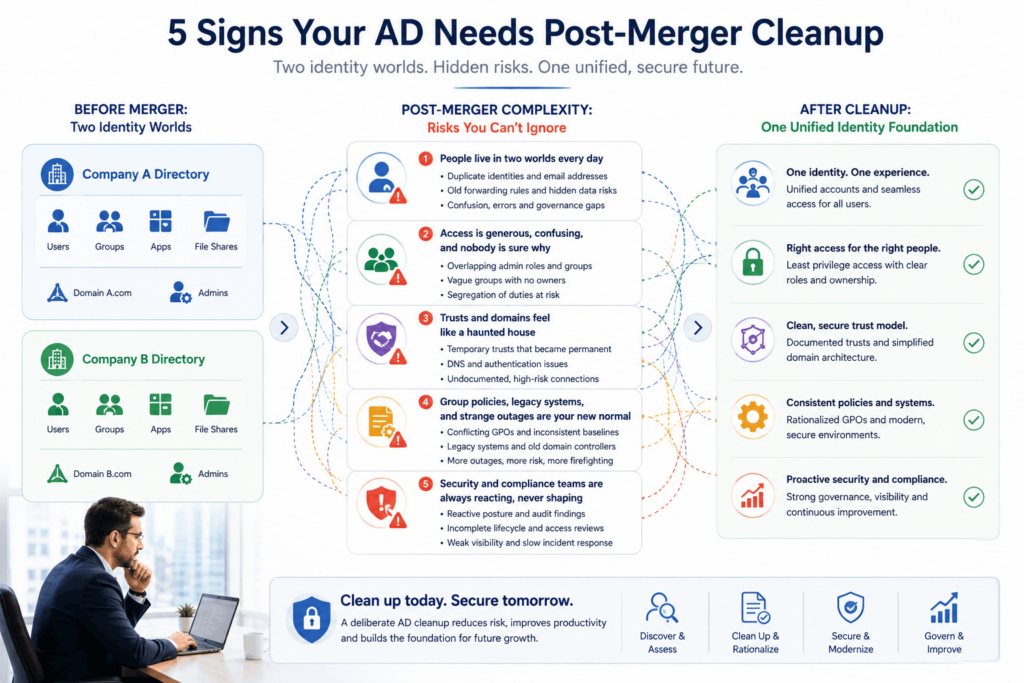
Sign 3: Trusts and domains feel like a haunted house
Forest and domain trusts are powerful, but after a merger they’re often built under intense time pressure: “Sales needs to access that CRM by Monday; just make it work.” Months later, those quick fixes remain – undocumented, unmonitored, and increasingly risky.
Warning signs here include:
- Forest trusts created “temporarily” to bridge environments that have now become permanent plumbing.
- DNS oddities where name resolution sometimes fails, or sends users to the wrong resource, depending on where they are.
- Authentication taking a long path across domains because nobody rationalized the topology after go‑live.
Poorly planned trusts can
- Bypass security boundaries in ways that attackers can exploit.
- Make it impossible to enforce consistent policies, because two forests don’t share the same view of identity.
- Turn incident response into forensic archaeology: “Which trust was used here? Who configured it? What else does it connect to?”
If your architecture diagrams no longer match reality, or if new admins are told “don’t touch that trust, it’s fragile,” you’re overdue for a trust and domain health assessment, and possibly consolidation.
Sign 4: Group policies, legacy systems, and strange outages are your new normal
When you merge two AD environments, you don’t just merge people, you merge every long‑forgotten group policy, script, and legacy system that depended on them.
Common symptoms:
- Random login or performance issues that only hit people from “the old company” or “the new company,” depending on which GPO applies.
- Applications that suddenly fail because a GPO, OU restructure, or schema change affected how they authenticate.
- Legacy domain controllers on old OS versions that everyone knows are vulnerable, but nobody has time to decommission.
When group policies from two worlds collide
- Security baselines may be weakened to keep legacy apps alive, dragging the entire environment down to the “lowest common denominator” of authentication and configuration.
- Conditional access and modern controls can’t be uniformly applied because not all systems or domains support them.
- Troubleshooting becomes slower and riskier; every change has unknown side effects in some forgotten OU.
This is where the merger silently taxes your future. Every week spent firefighting GPO conflicts or nursing old domain controllers is a week not spent on modernization. Post‑M&A cleanup here means inventorying GPOs, rationalizing policies, retiring legacy dependencies where possible, and designing a coherent OU and delegation model for the new organization.
Sign 5: Security and compliance teams are always reacting, never shaping
Perhaps the clearest sign your AD needs post‑M&A cleanup is when security and compliance live permanently in “catch‑up mode.”
Typical patterns:
- Security was only lightly involved during integration; most directory decisions were made by project teams under time pressure, not by identity architects and security leaders.
- New audit findings keep surfacing around account lifecycle, privileged access, and incomplete deprovisioning from the acquired environment.
- Zero Trust, MFA, or conditional access strategies stall because the underlying directories are too fragmented and inconsistent.
Without security at the table early, mergers create
- Shadow administrators and untracked privileged accounts across both directories.
- Inconsistent logging and monitoring, making it hard to trace who accessed what, from where, and under which identity.
- Data residency and regulatory issues when users authenticate through domain controllers in the wrong regions or carry legacy access into new jurisdictions.
When security teams spend their time writing compensating controls, exceptions, and one‑off monitoring rules just to cope with directory complexity, it’s a red flag. A cleanup initiative gives them a chance to reset: align AD with modern security principles, rebuild clear ownership, and make auditability a design feature rather than an afterthought.
What a thoughtful post‑M&A AD cleanup actually looks like
If you see yourself in several of these signs, the answer is not “one more script” or “a bigger Excel matrix.” It is a structured, human‑aware cleanup effort that treats identity as a foundation, not plumbing.
A practical approach usually includes
- Discovery and mapping: Create a clear picture of both environments: users, groups, OUs, GPOs, trusts, domain controllers, and dependent systems.
- Strategy before tooling: Decide your end‑state, single forest, multiple but tightly governed forests, or hybrid with cloud identity, then choose tools and migration methods that serve that design.
- Identity rationalization: Consolidate duplicate accounts, align naming standards, and give every user one clean, primary identity in the new organization.
- Access redesign, not just cleanup: Use the merger as a chance to rebuild role‑based access and delegation instead of merely pruning old groups.
- Security embedded, not bolted on: Have security and compliance leaders co‑own decisions about trusts, privileged access, and migration sequencing.
Throughout this process, communication matters as much as scripts. People need to know why they’re being asked to change passwords, lose legacy access, or adopt new names. When you explain that this is about protecting their work and making their daily experience smoother, you turn cleanup from a nuisance into a shared goal.
A quick way to gauge your own environment
To bring this down to earth, here’s a simple litmus test. If you answer “yes” to three or more of these, your AD likely needs focused post‑M&A attention:
- Do users regularly switch between old and new accounts or domains to get work done?
- Are there admin‑level accounts in the acquired environment that nobody has fully reviewed or re‑justified?
- Do you have trusts or domains that everyone is afraid to touch, but that still carry production traffic?
- Are GPO conflicts, odd login behaviors, or “only for the old company users” issues a recurring theme in your ticket queue?
- Do security and audit findings frequently trace back to directory complexity or inconsistent identity data?
If the answer is yes, you’re not alone; this is more common than most leaders realize. But it’s also fixable, with intent.
Turning the merger from mess to backbone
Active Directory rarely makes the front page of an M&A announcement. Yet it quietly decides whether the new company feels like one team or a patchwork of former rivals sharing a logo.
Cleaning it up after a merger is not glamorous work. It’s long workshops, careful inventories, painstaking permission reviews, and sometimes hard conversations about what will be retired. But the payoff is real: fewer outages, cleaner audits, reduced attack surface, and a workforce that finally logs in once, to one world, that makes sense.
If your post‑merger days feel like living in two companies at once, that’s your AD asking for help. The sooner you listen, the sooner the merger starts delivering what it promised.
Conclusion
When a merger is fresh, it’s easy to obsess over branding, board slides, and big strategic bets while quietly hoping the identity plumbing “just works itself out.” It never does. Every orphaned account, zombie domain, and mystery security group is really a decision deferred, and those decisions compound over time. The good news is that post‑M&A AD cleanup isn’t about perfection; it’s about intent. It’s the moment you stop treating your directory as a historical record and start treating it as a design choice for how this new company will actually function.
Think about what a healthy, post‑cleanup world feels like. Users log in once, everywhere, without juggling identities or calling the helpdesk to guess which account to use. Admins sleep better knowing there aren’t forgotten trusts quietly expanding your attack surface. Security and compliance stop being “the team that says no” and become partners shaping how access should work. Most importantly, IT finally steps out of permanent firefighting mode and back into building mode. That’s when you know the merger has truly landed, not just on paper, but in the daily rhythm of how your people work.
Beyond Active Directory cleanup, proper infrastructure governance is essential. Learn more about structuring Azure Landing Zones after a merger to avoid long-term technical debt
Frequently Asked Questions (FAQs)
Why do mergers create so many problems in Active Directory environments?
Mergers bring together two completely different identity universes: separate forests, domains, naming standards, security models, and access philosophies. Under pressure to “make it work quickly,” IT teams often stand up trusts, duplicate accounts, and temporary workarounds instead of a thoughtfully designed, unified AD strategy. Over time, these short‑term fixes become permanent. Users end up with multiple logins and inconsistent experiences. Admins juggle overlapping groups and policies that were never meant to coexist. Security teams inherit blind spots around privileged access, legacy domains, and unmanaged trusts. None of this is visible in boardroom M&A slides, but it’s painfully obvious in the day‑to‑day: strange outages, confusing permissions, audit findings, and a constant sense that the environment is fragile. The merger isn’t what breaks AD; it exposes everything that happens when identity isn’t treated as a core part of the integration plan.
What are the most obvious signs our AD needs post‑M&A cleanup?
Several human, everyday symptoms show that your AD is struggling after a merger. Users may juggle multiple accounts or email addresses just to get work done, living in two worlds that never truly merged. Helpdesk tickets about login problems, odd permissions, or inconsistent access pile up, especially from “old company” vs “new company” users. Admins find themselves afraid to touch certain domains, GPOs, or trusts because “nobody really remembers how they were set up.” Security groups and roles multiply with vague names and unclear owners, but nobody dares clean them up. Legacy domain controllers linger on outdated operating systems because critical apps still depend on them. Security and compliance teams spend more time writing exceptions and compensating controls than shaping a coherent access strategy. When running and maintaining AD feels like archaeology and firefighting instead of engineering, it’s a strong signal that the environment needs structured post‑M&A cleanup.
How does living with two identities affect users and the business?
When users effectively live with two identities, old domain and new domain, it slowly erodes productivity, trust, and security. People waste time remembering which account unlocks which system, or they maintain risky workarounds like forwarding email between domains, storing passwords in notes, or sharing old credentials informally. Collaboration tools, calendars, or file shares may behave differently depending on which identity someone uses, making teamwork feel disjointed. Onboarding and offboarding become more error‑prone: an employee leaving the company might have one account disabled while another quietly remains active. Managers and HR lose a clear view of who has access to what. Over time, this dual‑identity limbo sends a subtle message: the merger is unfinished, and IT never truly “brought us together.” Cleaning this up, consolidating accounts, standardizing naming, and giving every user one primary identity, doesn’t just reduce risk and complexity; it makes the merged company feel genuinely unified in daily practice.
Why is permission sprawl so dangerous after a merger?
Permission sprawl is what happens when you layer the old company’s access model on top of the new company’s without truly reconciling them. Users keep their legacy rights “just in case,” then gain new ones in the merged environment. Over time, access reflects history rather than role or business need. This is dangerous for several reasons. First, it quietly breaks least‑privilege principles: people have far more access than they need, widening the blast radius of any compromised account. Second, it creates segregation‑of‑duties issues where a single person can now perform conflicting actions across systems that were once separated. Third, it makes audits painful; managers reviewing access see cryptic group names, overlapping rights, and no clear owners. Nobody wants to remove anything because the impact is unclear. Post‑M&A cleanup that maps roles, rationalizes groups, and rebuilds access based on current responsibilities is critical to regaining control and reducing attack surface.
How do messy trusts and multiple domains turn into security and stability risks?
Trusts and multiple domains are powerful tools, but after a merger they’re often implemented under intense time pressure with minimal documentation. Over time, these “temporary” bridges become opaque and fragile. Poorly understood trusts can unintentionally weaken security boundaries, allowing access paths between forests or domains that nobody actively governs. A compromise in one environment might give attackers a foothold into the other through misconfigured or overly permissive trust relationships. On the stability side, authentication and name resolution can behave oddly: slow logins, inconsistent access, or systems resolving to the wrong resources. Admins may hesitate to retire old domains or rework trusts because they’re unsure which applications rely on them. This creates a haunted‑house feeling, where everyone tiptoes around certain parts of the topology. A deliberate cleanup, inventorying trusts, validating their necessity, simplifying domain structures, and aligning with a clear end‑state design, turns this fragile mesh back into an understandable, governable architecture.
What role do group policies and legacy systems play in post‑M&A AD chaos?
Group policies and legacy systems are where many of the ugliest post‑M&A surprises live. Each company comes with its own library of GPOs, some well‑documented, others long forgotten but still impactful. When forests or domains are connected, those policies can overlap, conflict, or apply in unexpected ways. Users from one side of the merger may suddenly experience different security settings, login scripts, or application behavior than those from the other side. Legacy applications that depend on old protocols, outdated OS versions, or specific OU structures can block progress, forcing the entire environment to stay at a weaker security baseline just to keep them alive. This leads to random outages, slow troubleshooting, and a culture of fear around changing anything. Post‑M&A cleanup means discovering all active GPOs, rationalizing and consolidating them, identifying legacy dependencies, and building a modernization plan that moves the organization toward a consistent, secure policy baseline.
How do security and compliance teams get stuck in “reaction mode” after a merger?
When AD integration is rushed, security and compliance are often invited in late, after major directory decisions are already baked into production. They inherit an environment with shadow admins, inconsistent logging, fragmented identity data, and unclear ownership over groups and trusts. Instead of designing proactive controls, they spend their days reacting to issues: responding to audit findings, writing comp, ensating controls for risky trusts, approving endless one‑off access exceptions, or explaining why certain Zero Trust or MFA initiatives can’t be rolled out consistently. Incidents and near‑misses are harder to investigate because identities are duplicated, permissions are scattered, and historical changes weren’t tracked clearly. This constant firefighting prevents security teams from driving a strategic agenda. A structured AD cleanup gives them a chance to reset: define clear privileged access models, standardize logging and monitoring, and align directory design with security frameworks so they can move from reacting to shaping the environment.
What does a successful post‑M&A AD cleanup journey look and feel like?
A successful post‑M&A AD cleanup is less about a single big bang and more about a deliberate, transparent journey. It usually starts with discovery: mapping users, groups, OUs, GPOs, trusts, and legacy systems across both environments. Then comes defining the end‑state—one forest, several curated forests, or a hybrid with cloud identity at the center. From there, teams gradually consolidate accounts, unify naming standards, and redesign role‑based access rather than simply deleting old groups. Security and compliance are involved from the start, co‑owning decisions on trusts, privileged roles, and migration sequencing. Just as importantly, communication with the business is clear and honest: users understand why certain changes are happening and how these steps ultimately make their work easier and safer. When the journey succeeds, people log in once, systems behave predictably, audits get simpler, and IT shifts from always putting out fires to confidently building the next phase of the merged company’s identity strategy.